|
|
|
🚀 The AI Trend Oracle Report
The AI Industry Is Starting to Standardize. Brand Measurement Is Still the Wild West. |
|
Three of the world's largest AI labs are discussing shared standards for testing and auditing advanced AI systems. That's important. But for the companies trying to understand what those same systems believe, cite, recommend and choose, there is still no shared measurement standard. After the experiments I've run over the past month, I'm increasingly convinced that distinction matters. |
|
 |
|
|
|
|
|
🚨 This Week's Market Intelligence |
|
Google, OpenAI, and Anthropic have been meeting regularly since July, discussing an industry-led standards organization focused on testing and auditing frontier AI systems, according to reporting from The Information. It remains exploratory, no charter, no timeline, no announced commitments. OpenAI made its own position public independently on September 9, stating it wants to "work with other labs on industry-led standards" and will pursue "a voluntary effort now, with or without government support." Worth knowing: OpenAI frames that voluntary effort as something that complements, not replaces, the mandatory federal regulation it's separately pushing for in Congress. |
|
|
📊 What's Actually Happening |
|
The important signal isn't that AI companies have solved standardization. They haven't. It's that the industry has reached a point where even direct competitors are admitting that some questions can't be answered credibly if everyone is running a different test.
I've been running into the same problem from the other side of the screen. I changed an Axis Suite Evidence score from 40 to 20 after realizing I had counted four named source surfaces as four independent pieces of corroboration, when two of them shared an underlying content catalog and only represented two independent judgments. I also ran 120 queries, two engines times three ambiguous prompts times 20 repetitions, and found that each engine was remarkably consistent with itself, but two of the three prompts got interpreted as a different type of task depending on which engine answered them.
Neither finding means anyone's methodology is wrong. It means the number can't be separated from the method that produced it. |
|
|
🎯 This Week's Strategic Lens |
|
A CMO doesn't need every AI lab to agree on one universal AI Visibility Score. But leadership does need to know what's underneath the number being presented in the boardroom. Which engines were tested. Which prompts. How many repetitions. What counted as a recommendation. Whether cited sources were actually independent judgments, or fewer than they looked. What wasn't measured at all. A number without those answers isn't necessarily wrong. It's incomplete. |
|
|
👨💻 Founder's Note |
|
A month ago, I probably would have read this as an AI governance story and moved on. I read it differently now.
In the last few weeks, I cut an Axis Suite Evidence score from 40 to 20 after realizing I had counted multiple source surfaces as more independent corroboration than they actually represented. I ran 120 queries and found that identical ambiguous prompts could be interpreted as different tasks by different engines, even when each engine was remarkably consistent in its own interpretation.
Neither finding made me want a cleaner number. They made me want a more explainable one.
That's increasingly the standard I'm trying to build into Axis Suite. Not pretending uncertainty can be eliminated, but showing enough of the evidence and method underneath a conclusion that someone can understand why it exists.
- Dana Billingsley | Founder, Axis Suite
|
|
|
|
Practical Section |
|
Before accepting any AI visibility number, ask five questions. What exactly was measured. Which engines and prompts produced it. What counts as a mention, a citation, or a recommendation. What wasn't measured, or couldn't be determined. And can you see the evidence underneath the conclusion.
You don't need every vendor to use the same methodology. You need enough transparency to understand the one you're looking at. |
|
|
☕AI Caffeinated Wisdom |
|
A measurement standard doesn't have to make everyone agree. It has to make disagreement explainable. That's been true of every argument I've had with my own Evidence scores this month, and it'll probably be true of the next one too.
Stay steady. ☕ |
|
|
🔔 CLOSING SIGNAL |
|
|
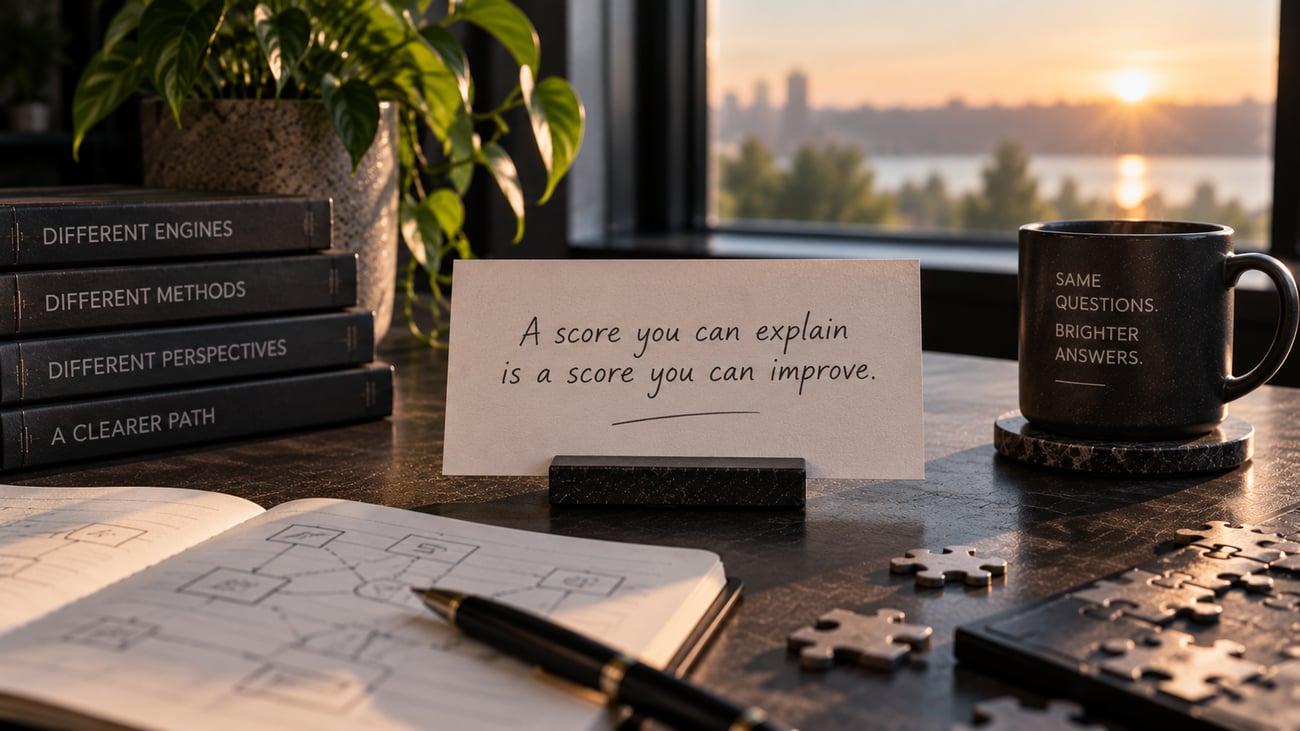
AI measurement will probably stay messy for a while. Different engines will behave differently. Different methodologies will produce different numbers. Models will change underneath us. The answer isn't pretending those differences don't exist. It's making them visible enough to diagnose. A score you can explain is a score you can improve. |
|
|
|
|
🛠 Coming Next Week
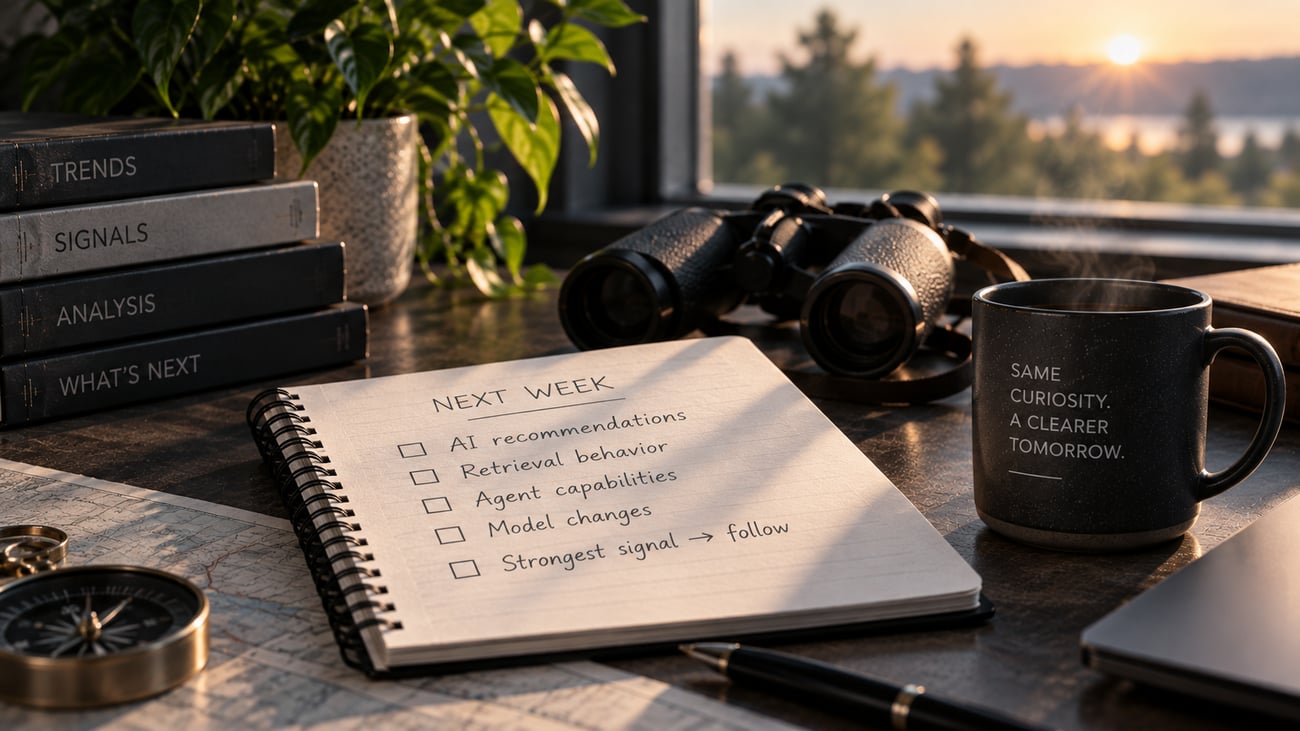
I'm watching several changes across AI recommendation, retrieval, and agent behavior this week. I'll follow whichever one produces the strongest signal rather than forcing next week's conclusion before the evidence gets here. |
 |
|
|
|
|
🚀🤖✨📊🎨
The Axis Suite
AI Recommendation Intelligence. AI Narrative Defense. Agentic Visibility Infrastructure. |
|
"Axis Suite is the independent intelligence layer that explains what AI believes about your brand, why it believes it, and what decision that belief ultimately drives."
👉 Axis Suite | Read the Proof Center
📬 Thank you for being part of this.
Here's to staying visible, staying understood, and becoming the obvious choice.
Stay caffeinated, stay inspired. See you next week! ☕
From the trenches,
The Axis Suite Team 💪
|
|
|
 |
|
© 2026 TrendAxis, LLC™. All rights reserved.
|
|
|