|
|
|
🚀 The AI Trend Oracle Report
What Should CMOs Actually Measure About AI? |
The standard arrived this month. It is better than what we had. It still leaves out the question executives ask second.
For most of the past year, every conversation about AI visibility measurement ran into the same wall. Everyone was measuring something. Nobody agreed on what.
That changed on August 3.
The IAB published Measuring Visibility in the AI Era, the first real attempt at a shared vocabulary for this market. And it is good. Better than I expected. It is also the reason I want to talk about measurement this week instead of another framework.
Because the standard answers a question CMOs have been asking for a year. And it does not yet answer the one they ask about ten seconds later. |
|
 |
|
|
|
|
|
🚨 Market Intelligence |
|
The Measurement Conversation Grew Up
The IAB's guidance opens with a problem that will sound familiar to anyone who has shopped for an AI visibility tool.
More than 20 companies now sell AI visibility measurement. They use different methodologies. They produce materially different results for the same brand.
Which means a CMO could buy two platforms, scan the same company, and walk into the executive meeting with two versions of reality.
The IAB's answer was not another score. It was structure. Four pillars, which they call the Four P's:
Presence. Does the brand appear at all? Mention rate, citation rate, share of voice, visibility momentum.
Prominence. Where and how prominently? Placement, ranking, how substantively the brand is covered.
Portrayal. In what context, and how accurately? Sentiment, framing, hallucination rate, factual inaccuracy rate.
Persuasion. Does the visibility drive action? Recommendation strength, post-citation click-through.
Then it did something more useful than the pillars. It split measurement into two tiers.
Directional measurement is fine for trend spotting and internal briefings. Under 50 queries, at least two intent types, monthly or quarterly testing.
Decision-grade measurement is what you need before you move budget. Large, diverse query sets across all four intent categories. Weekly or more frequent testing. Reproducibility with defined variation ranges and stated confidence levels.
And one line in that document is worth the entire read:
"Single-response measurement is not measurement."
If your vendor hands you a screenshot, you have an anecdote. If your vendor hands you a number with no range around it, you have false precision. AI answers are probabilistic. They shift by prompt, by session, by platform, by model update. A single value implies a stability that does not exist.
Worth noting alongside all of this: only about 16 percent of brands systematically track AI visibility today. Most of this market has not started. |
|
|
📊 What's Actually Happening |
|
Two Studies Just Made This Commercially Urgent
Measurement standards matter more when there is something worth measuring. In June, two separate pieces of research put numbers on that.
Similarweb, published June 23, tracked user behavior across finance, travel, and beauty. Users who received an AI recommendation were 2.5 times more likely to visit that brand's site within seven days. Those visitors viewed nearly twice as many pages and stayed roughly twice as long. And more than 56 percent of that AI-influenced traffic arrived through branded search, compared with about 40 percent for standard visits.
Read that last number again. The influence happened in the AI conversation. The visit was recorded as branded search.
A preprint from Scrunch AI, posted to arXiv on June 9, joined opt-in clickstream data to users' ChatGPT, Claude, and Gemini conversations. Among users with no recent observed engagement with the brand, the effects were:
| Behavior |
After an AI recommendation |
After a neutral mention |
| Branded search |
+4.3 percentage points |
+1.8 pp |
| Brand site visit |
+2.4 pp |
+1.1 pp |
| Retailer page visit |
+1.0 pp |
+0.3 pp |
The gap between those two columns is the finding. A recommendation moved behavior roughly two to three times more than an incidental name-drop.
Which means counting AI mentions as if they are interchangeable may be the most expensive measurement mistake this industry makes next. Mentioned and recommended are not the same commercial event, and treating them as one number hides the difference |
|
|
🔍 Featured Insight |
|
The Evidence About AI Recommendation Has Its Own Evidence Problem
Here is the part I have not seen anyone write about, and it has been sitting in front of all of us for six weeks.
That arXiv preprint is the strongest observational evidence available that AI recommendation moves buyers. Its authors are Scrunch AI, a company that sells AI visibility measurement.
In the paper, they decline to report panel size, per-analysis user counts, or per-cell sample sizes. Their stated reason is that those figures are commercially sensitive. They assert the estimates clear an internal minimum-disclosure threshold by a wide margin, and they built real controls into the design: pre-trend event studies, backward-placebo windows, a stance classifier separating recommendations from name-drops.
I am not accusing anyone of anything. The methodology looks careful. The controls are more rigorous than most vendor research I read.
But six weeks after that paper posted, the IAB defined decision-grade measurement as requiring reproducibility, disclosed variation ranges, sample sufficiency, and methodology transparency.
So the best available proof that AI recommendation drives commercial behavior does not currently meet the standard the industry just set for itself.
That is not a scandal. It is a growing pain, and an honest one. But it tells you something about where this market is.
We have entered the phase where evidence about AI visibility has to survive the same scrutiny we tell clients their brand evidence must survive.
I have been arguing for months that AI does not trust claims, it trusts convergence across independent sources. That argument applies to vendors too. It applies to me. If Axis Suite publishes a finding, the sample, the method, and the variation range should travel with it. Otherwise I am asking the market to take my word for it, which is exactly the position I tell brands not to be in.
The uncomfortable version: a lot of what gets circulated as AI visibility research right now is marketing with a methodology section. |
|
|
🎯 This Week's Strategic Lens |
|
The Four P's Measure a Moment. Nothing Measures Whether It Holds.
Go back through the IAB pillars and notice what each one describes.
Presence: did you appear? Prominence: where did you appear? Portrayal: how were you described? Persuasion: did that appearance move someone?
Every one of those is a measurement of an event. A response happened. Something was true about that response.
None of them asks the question a CMO asks second.
Does it still happen next week?
Change the prompt. Add a constraint. Change the company size in the scenario. Ask a follow-up. Run it on a different platform. Run it after the next model update. Are you still there?
That is not a fifth P and I am not going to give it a clever name. It is a question, and it is the one I would add to any AI visibility report before I let it inform a budget decision.
The reason it matters is structural. Presence, prominence, portrayal, and persuasion can all be true once and false the following Tuesday. A brand can look excellent in a Monday scan and vanish from the same query on Friday because the model updated, or because the evidence behind the recommendation was thin enough that one new comparison article displaced it.
The distinction I keep coming back to:
One recommendation is an event. Repeated recommendation is a position.
You cannot build a strategy on an event. You can build one on a position.
And this is exactly where the two halves of this week's news meet. The IAB says single-response measurement is not measurement. The correct response to that is not just more queries. It is repeated queries over time, so you can see whether what you measured was a fluke or a foundation.
A brand that appears in eight out of ten runs of the same buying question has something. A brand that appeared once, screenshotted it, and put it in a board deck has a screenshot.
|
|
|
|
👨💻 Founder's Note |
|
I used to think the hard part of this market would be figuring out how to measure AI visibility.
I do not think that anymore. We can measure quite a lot. Some of it fairly well.
The harder problem is deciding what deserves to become a business decision.
I changed my mind about something else this month too. When the IAB guidance came out, my first reaction was competitive. Some part of me wanted the vocabulary for this category to come from the people who have been in the trenches building it, not from a standards body.
That reaction was wrong, and it took me about a day to see why.
A standard is not a threat to an independent intelligence layer. A standard is what makes independent intelligence legible. Before August 3, every vendor in this space was arguing about definitions. Now there is a shared floor. Which means the conversation can finally move to the part that actually differentiates anyone: not what you measure, but what you can explain.
If a company's AI visibility score drops ten points, I do not want to tell a CMO their score dropped ten points. I want to tell them their recommendation presence held, they were displaced by a specific competitor in six high-intent queries, the change is concentrated in comparison scenarios, and here are the sources feeding that competitor's advantage.
One of those is reporting. The other is intelligence.
Executives do not need another AI dashboard. There are plenty of those already. They need enough understanding to make a better decision.
- Dana Billingsley | Founder, Axis Suite |
|
|
🛠 THE 10-MINUTE CMO MEASUREMENT CHECK |
|
Pull up whatever AI visibility report your team last handed you. Run it against five questions.
1. Presence. Does this tell me whether we appear in the buying conversations that actually matter, not just the broad category term? "Best CRM platforms" and "best CRM for a 200-person B2B SaaS company replacing HubSpot" are different conversations. Your report should reflect the second one.
2. Prominence. When we appear, where are we? First, third, or a footnote after the recommendation has already been made?
3. Portrayal. How were we described? Which category were we placed in? Was anything about us wrong? Inaccurate portrayal at high prominence is worse than modest prominence with accurate portrayal.
4. Persuasion. Was the language confident or hedged? "A strong option for teams that need X" and "you could also consider X" are not the same recommendation, and the June research suggests they do not produce the same downstream behavior.
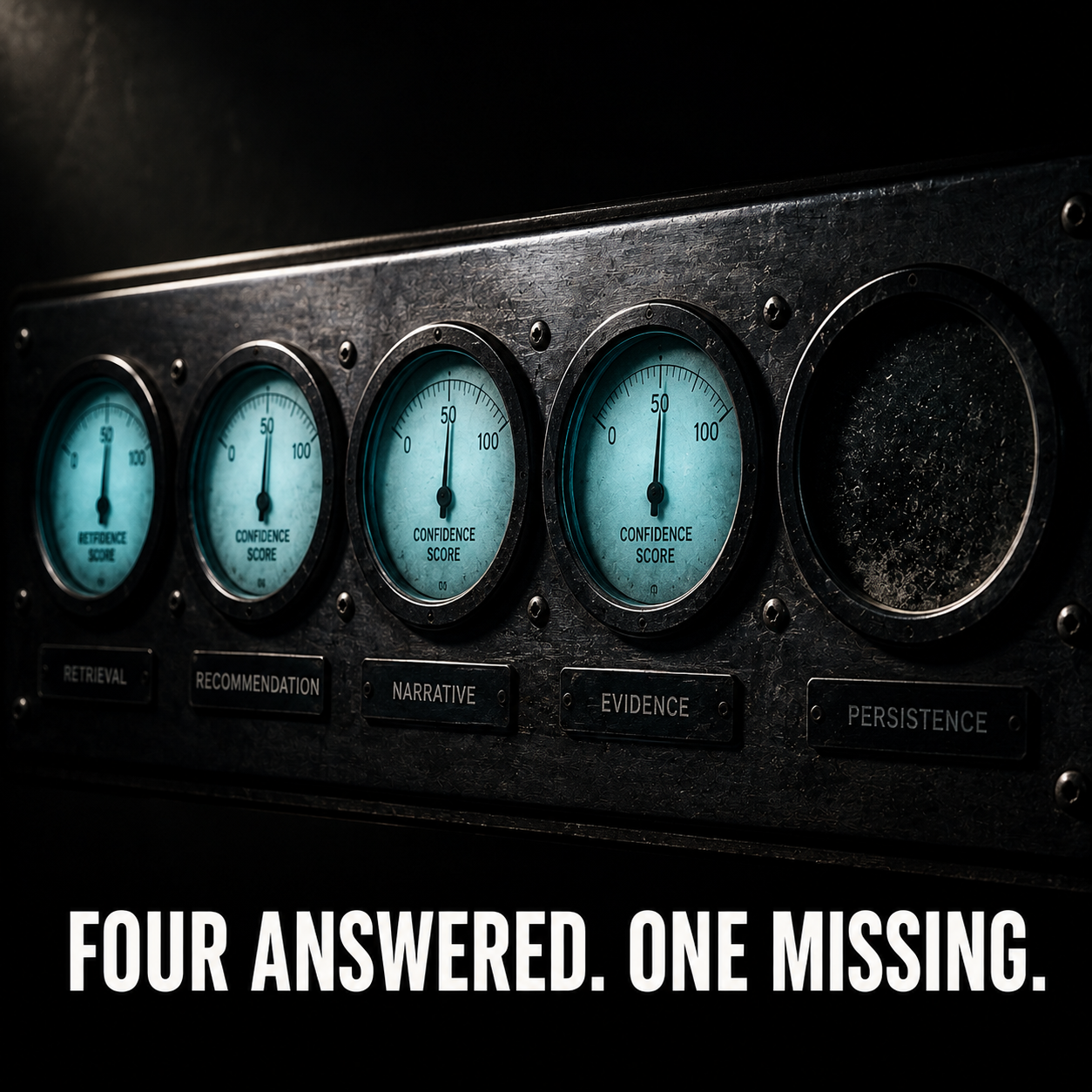
5. Persistence. Does the report tell me whether any of the above held across prompts, sessions, platforms, and weeks? Or is it a snapshot?
Then ask one question about the report itself, which is the IAB's real contribution:
Is this directional or decision-grade? How many queries, across how many intent types, run how often, with what variation range? If your vendor cannot answer that, you have a trend indicator. Useful. Just not something to move budget against.
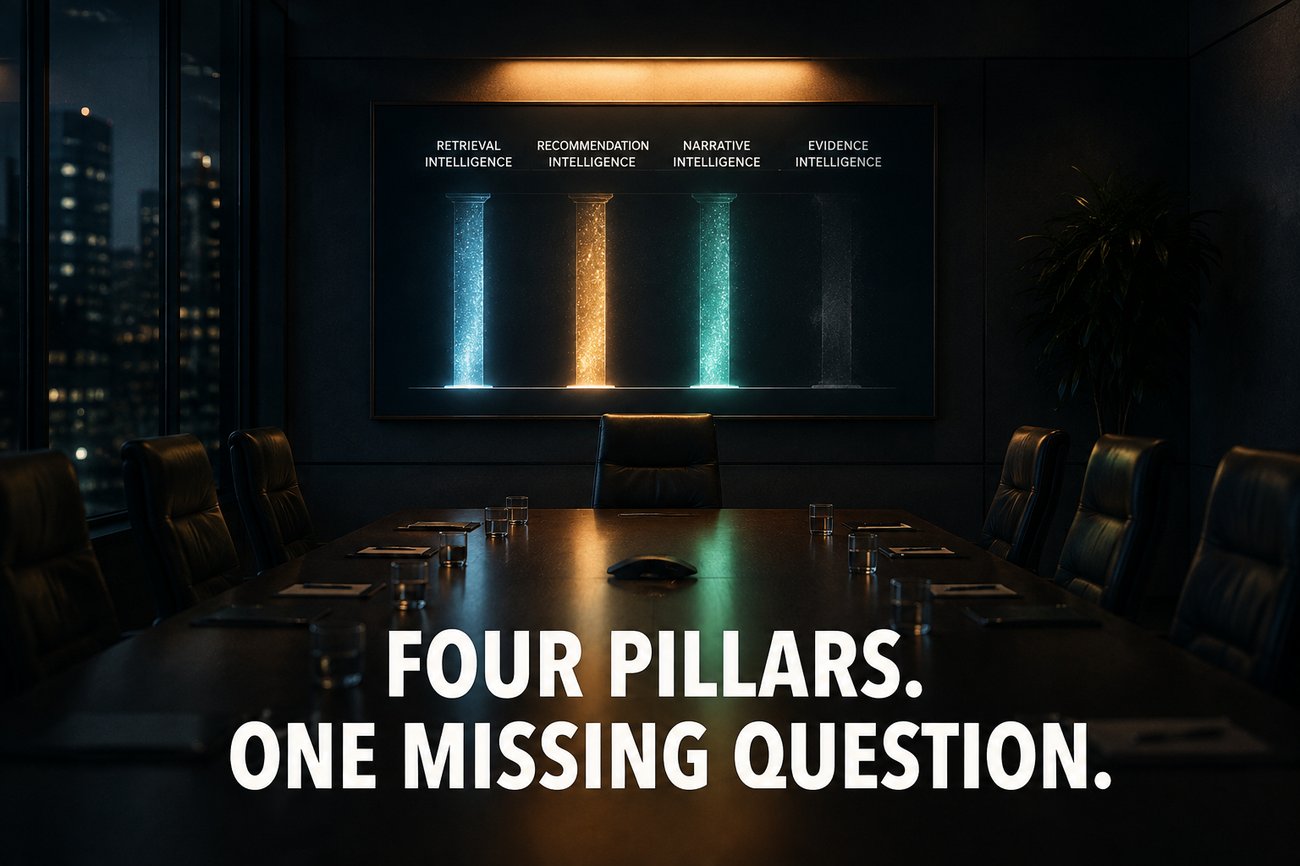
If your report answers one or two of the five, you have visibility measurement. If it answers four, you are approaching Recommendation Intelligence. If it answers all five and tells you what changed and why, AI stops being a marketing metric and starts being acquisition intelligence. |
|
|
☕AI Caffeinated Wisdom |
|
|
Your Weekly Dose of Caffeinated Wisdom
Nobody buys a used car on one lap around the block.
The car starts. It sounds fine. The seller smiles. And every reasonable buyer still says some version of: let me take it on the highway. How does it start cold? What does it do in traffic? Can I see the service records?
Not because the lap around the block was fake. It was real. The car genuinely started.
Because one start is not reliability. Reliability is what happens on the four hundredth start, in February, when nobody is watching and there is no sale to close.
The buyer is not asking for more information. They are asking for the same information, repeated under different conditions.
That is the whole thing.
A screenshot of ChatGPT recommending your brand is the lap around the block. It is real. It happened. It is also the least demanding condition your brand will ever be measured under.
The question worth paying for is what happens on the four hundredth query, after the model update, when a competitor published something new last week.
Stay steady. ☕ |
|
|
🔔 CLOSING SIGNAL |
|
AI visibility became measurable this month in a way it was not before. That is real progress and the IAB deserves credit for it.
Now comes the harder part, which is making it meaningful.
Presence tells you that you showed up. Prominence tells you where. Portrayal tells you how you were described. Persuasion tells you whether it moved anyone.
Persistence tells you whether any of it is a position or an accident.
And underneath all five sits the question this month quietly put on the table: can the evidence itself withstand inspection? Yours, your competitor's, and your vendor's.
The brands that win the next phase will not be the ones with the most measurements. They will be the ones who can explain which changes mattered, why they happened, and what to do next. |
|
|
|
|
🛠 Coming Next Week
We keep treating recommendation as something you win.
Next week I want to look at it as something that accumulates. How AI trust compounds over time, why the fifth or sixth consistent signal is worth more than the first four combined, and what it takes for a belief about your brand to stop needing to be re-earned every time someone asks.
Getting recommended is an event. Staying recommended is an asset.
|
 |
|
|
|
|
🚀🤖✨📊🎨
The Axis Suite
AI Recommendation Intelligence. AI Narrative Defense. Agentic Visibility Infrastructure. |
|
"Axis Suite is the independent intelligence layer that explains what AI believes about your brand, why it believes it, and what decision that belief ultimately drives."
👉 Axis Suite | Read the Proof Center
📬 Thank you for being part of this.
Here's to staying visible, staying understood, and becoming the obvious choice.
Stay caffeinated, stay inspired. See you next week! ☕
From the trenches,
The Axis Suite Team 💪
|
|
|
 |
|
© 2026 TrendAxis, LLC™. All rights reserved.
|
|
|
|
|